Showing posts with label Shoot 1. Show all posts

Friday, 21 April 2017

Shoot One Straight Images


I photographically documented the volunteer performing many of the main work tasks in caring for the dogs at the centre. These illustrate the breadth of tasks involved, and I can now analyse these to progress my images and make improvements. The tasks I captured on this first shoot were.


  •            opening/closing/bolting of exterior/kennel doors
  •  scrubbing of the kennel blocks floor
  •           topping up of water bowls
  •           preparation and distribution of the dogs meals
  •           closing of the dogs hatches
  •           interacting with some of the animals (cat/dogs/donkeys)
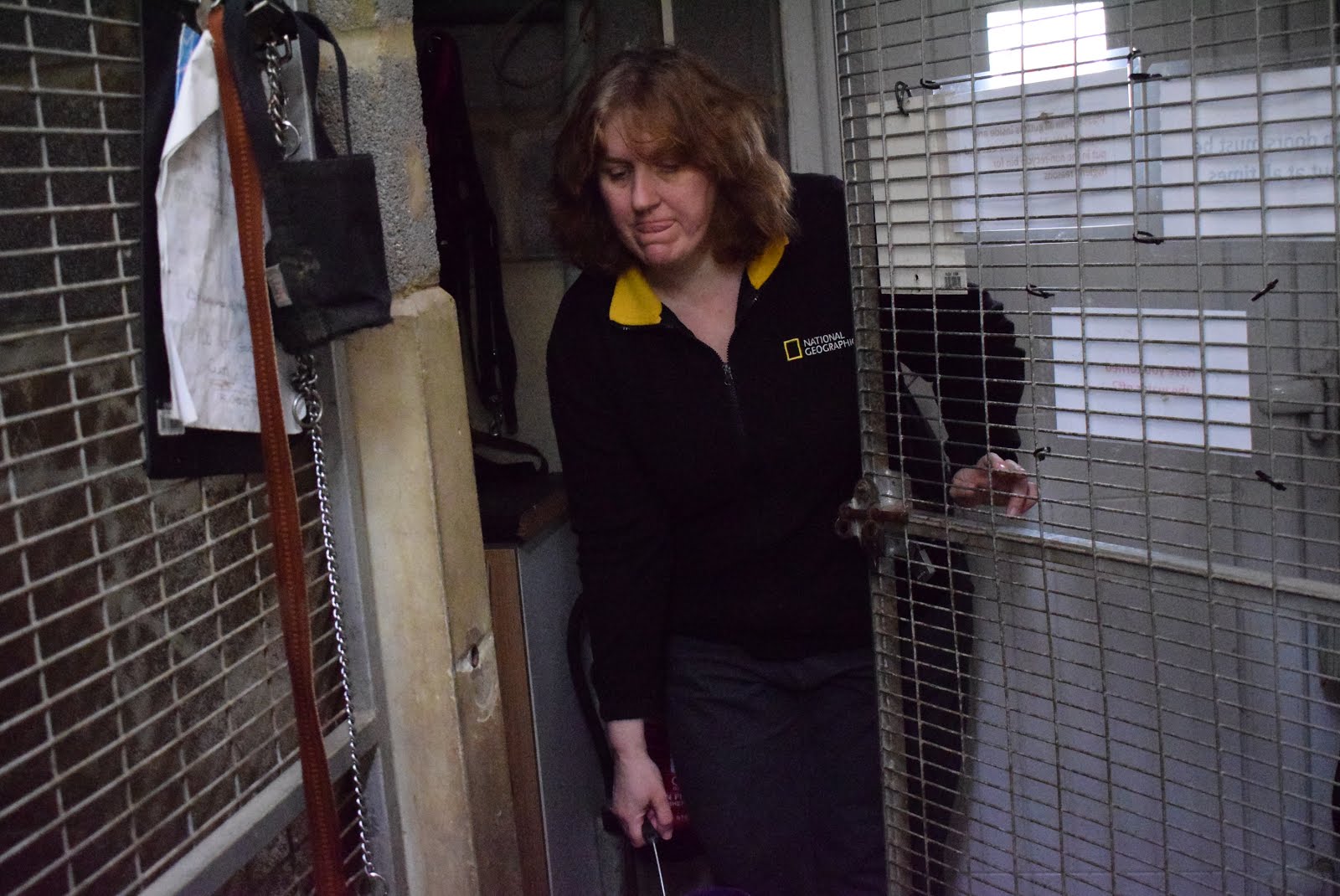


    In two of the images I have focused on the security systems in place at the centre. There are many bolted door and double entry doors which are to ensure the dogs do not come into close contact with each other as this could result in a fight, as well as to prevent dogs from escaping should an individual door be accidentally left open. I photographed the worker opening the security bolt on the door as well as them entering through the double entry doors. There are also security concerns with criminals stealing dogs from centres for use in sports, so security is very important.

    I also photographed a sign reminding workers to remove partially eaten dinners in order to not encourage flies.

    I photographed the workers performing the cleaning tasks including the scrubbing and disinfecting of the kennel blocks floor, which is one of the main routine tasks at the Centre.

    I took images of the preparation of the dogs’ meals in the kitchen area.


    I then showed the meals being distributed to the dogs in their individual kennels as well as the topping up of their water bowls and the closing of the dogs heavy hatch doors which lead to their runs.


    I also captured images of the worker interacting with some of the animals such as the worker holding two dogs here.  Taking photographs that could be shared on social media such as Facebook pages and web sites is an important part of advertising the availability of the dogs to aid in the chances of them being rehomed.


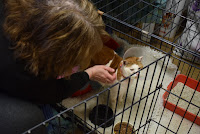
    I captured images of workers interacting with some of the animals at the centre, including giving an injured cat some much needed attention. 


    Interacting with an inquisitive donkey. 


    I also photographed myself as I talked gently to one of my favourite dogs Tarquin. I took this in close up to make it more expressive and intimate so it connects more with the viewer.


    I selected number of the images to adapt in Photo shop.


    In this image I wanted to make the worker really stand out more so that he focus was more on her. In Photoshop I starkly decreased the brightness of the image so that the background was less distracting. I like the way in the photo shopped image that the fluorescent strip lights have stayed prominent, so that they still point towards the worker leading the viewers eye to her and making her the focus of attention. I also like the way the top of the workers head and both her hands are highlighted as this focuses the attention on the task that she is doing in scrubbing the floor and the care and attention she is taking doing it. The walls, fire hydrant and the kennels are considerably darker so are less prominent and do not take away focus from the worker. It would have been better if the worker was wearing lighter clothing rather than black jeans and jacket, so that her form would have been highlighted a little more as I feel she is a little too shadowed and fades into the background a little too much.


    There are a number of signs up around the Centre reminding the staff and new volunteers to complete certain tasks. These are important as many of the task are routine and can be boring so staff get complacent and also it helps to remind any new volunteers of any specific tasks they are likely to forget. I wanted to adjust the image in Photo shop so that the message on the sign stands out more. This will highlight the importance of the message and focus attention on it. To achieve this I adjusted the curves in the image. This makes the words in the sign really stand out in bright yellow, against the dark blue background so focusing attention on their importance.


    In this image I wanted to make Tarquin more easily seen, particularly around his eyes which I felt were the focus of attention but could be clearer. This would allow the viewer to connect more with him as he makes eye to eye contact with them and allow them to form a relationship with him. I also wanted to make the image have a more warmer harmonious feel to it. So wanted the image to look less orangey coloured and more natural. In Photoshop I increased the brightness, decreased contrast, then adjusted levels very slightly to make it brighter. I then used selective colour to get rid of the orange tones. I think the photoshopped image is more naturally coloured so more pleasing to the viewers eye. I also think that Tarquin's beautiful dark eyes are more clear and expressive in the image against the rest of the background so that they stand out more and can connects more with the viewer.

    Saturday, 4 March 2017

    Shoot One Work Record

    Plans for the Shoot

    I will take my images using my Nikon D5300 DSLR Camera and will adjust the settings for the different locations to suit each specific shot. It is my first shoot and it will take place in the morning of 12th February at Mutts in Distress (Mutts) in Little Hallingbury in Hertfordshire and I will be taking images inside buildings as well as outdoors.


    Mutts is a charity that takes in dogs that their owners can no longer care for, as well as abandoned strays and dogs from kill shelters in the UK, Ireland, Spain and Romania. They care for the dogs until they find them new homes. In addition to a large number of dogs the centre has also taken in other abandoned animals including four cats, two donkeys, 8 sheep, ducks, hens, three parrots and a shire horse. These animals are cared for at the centre and will live out their lives happily there.
    I really admire the staff at the animal centre for all the physically hard work and long hours they put in 365 days a year, to care for the animals that have lost their homes through no fault of their own, and those who have never had a home at all. I have been helping by volunteering at the centre for over a year now. As an animal lover I am passionate about animal welfare and intend to go to university to train to be a veterinary nurse when I have finished college. So the work that takes place at the centre is something that is very close to my heart and this is why I will focus on it for Documenting Contemporary Life.

    I plan to capture interesting and engaging images showing the physically hard work that takes place at the centre, the long hours they put in and the joy and satisfaction that you can get out of caring for animals.

    I know all the staff at the centre and have checked in advance that they are happy with me photographing them as they work. Additionally there are a number of volunteers who come to help out with the routine tasks and with exercising the dogs and they have also given their consent to being photographed by me.

    My plan on this first shoot is to follow around and photograph one of the workers as they carry out their normal daily work tasks. As the staff are very busy, and I don’t want to slow them down, I have asked one of the volunteers, Carol, if I can follow her as she has more time to spare if I need to do a bit of preparation for a shot.  I have asked her to ignore the fact that I am taking photos and not look at the camera. In this way my images will look natural and not posed for.

    What I Hope to Achieve

    In this first shoot I want to capture images of the main routine tasks that the workers do at the centre. This is the caring of the dogs there and the main tasks are:
    ·         Preparing the dogs meals
    ·         Feeding the dogs their meals and giving them fresh water
    ·         Cleaning of the kennels, including scrubbing and disinfecting the floors, squeegeeing them dry, changing the bedding in the baskets
    ·         Washing and drying the dog bedding

    I want these images to look natural so that viewers find them genuine and can connect more with the people in them. So I do not want the images looking posed for with the people looking directly at the camera.

    I want to test out some of my initial ideas, which I have planned in my head, and in a mind map, of what I think will make an engaging and informative image. I have quite a few ideas to try out, which I can then go on to develop or disregard. These images will visually illustrate the large amount of work that goes on at the rescue centre. Some of these images will also demonstrate that the work is quite physically demanding, especially as it is mostly women that work at Mutts, and I will try to capture this photographically.

    During this shoot I will focus on the physical hard work the staff do at the centre but in my project I also want to show that working there can be enjoyable and rewarding too. So if any opportunities come up to show this I will capture them. However the best day to shoot this will be on Thursday morning when the volunteers come in to exercise the dogs and I will therefore plan a shoot on this day to focus on that.

    What I Achieved
    I followed Carol, a volunteer at the centre, around as she performed the routine morning tasks of unlocking the double entry doors and padlocks to access the kennels.
     
    Once in the kennel block she pulled the cords to open the hatches to let the dogs into their runs.
    I photographed her preparing the dogs meals in the kitchen. 
    Then taking the meals to the dogs in their kennesl.
    I took many photographs and afterwards studied them to see what would convey, in an interesting way, the work that is done there. There were a number of images that I felt were potentially good but will work on them in later shoots to try to improve them.
    In my images I wanted to capture the respect and admiration I have for the staff and volunteers that work at Mutts. During my research on the photographer Lewis Hine I noted the way he respectfully portrayed workers. In a few of his images he made use of converging lines down a narrow corridor in a textile factory. He used these lines to focus attention on a worker standing there and I will similarly focus attention on my worker and their task using this technique. In the image I have photographed the volunteer scrubbing and disinfecting the kennel floor at the bottom of the corridor.


    This is a task that is done twice a day every day to all the kennels, runs and corridors. It is a physically demanding task as there is so much area to clean. I think it is clear to the viewer what the worker is doing in the image as she is holding a broom and there is a black bucket on the floor. I think I have composed this image effectively to focus attention on my subject and her task. The converging lines of the walls, ceiling and floors of the narrow corridor focuses attention onto the rectangular wall area at the end of the corridor, which acts as a frame. The fluorescent strip lights on the ceiling also form a line pointing towards this point. These straight lines therefore are leading lines directing the viewer’s eye to this focal point. This is where I have captured the subject’s form scrubbing the floor and framed by the back wall of the corridor. While the composition of the image is good, the image is a little blurred which was probably due to the poor lighting within the kennel area. Also there was a bundle of dirty bedding and some dog bowls on the floor which distracts attention from the subject. I think this image is a good starting point which I intend to develop in later shoots.  


    I also chose this image to photo shop as I wanted to make the image focus more on the worker and her task, to convey the importance of the work she is doing for the care of the dogs at the Centre. By decreasing the brightness of the image I made the background and objects in it less distracting. The worker can now be seen more clearly relative to her surroundings and her hands and the top of her head are highlighted and this focuses attention on the task she is doing in scrubbing the kennel floor with disinfectant. It would have been better if the worker was wearing lighter clothes as I feel she could be a bit more prominent in the image and as she is wearing black clothes she fades into the background a bit too much.


    There was also an unexpected opportunity to show some of the caring side of the work done at Mutts. One of the cats, Daisy, had just had a tumour surgically removed from her back leg and was being kept confined in a wire crate to allow her to rest her leg and let the stitches heal.


    I therefore took some images of Daisy being given some attention and affection by the staff, as she was desperate for an ear scratch as her neck collar prevented her having a good scratch there herself.
    I also managed to get Carol to pose holding two of the small dogs that were soon to be leaving Mutts as they had been found a new home. Mutts staff often take photos of the dogs to put on social media as a way of advertising dogs for rehoming to gain interest in them and of celebrating the success when homes are found.  I asked Carol to hold the dogs in her arms and didn't give any more specific instructions as I like my shots to look very natural and so appear genuine allowing the viewers to connect to them. 


    This image has some positive parts in that I have used the rule of odds, two dogs one person, to focus on the subject and not empty space. But would have conveyed more of an  emotional bond if the dogs would have made eye contact with the worker. They were however too excited and wriggled a lot so it was difficult for Carol to hold them for long.  

    There was also a funny event that occurred during the morning that I captured a few images of. The donkeys had been let out of their field to let them graze on the grass in the orchard and around the buildings. Carol had to move her car to allow easier access to one of the storage rooms and as she was sitting in the car one of the donkeys came right over to the window to look for some food, as Carol often gives them bread as a treat. I photographed her framed by the car window.


    This image reminds me of the images Raghubir Singh took from the window of his Ambassador car on travelling through India. However this image is more contemporary as it a Mercedes car window. I think the image is amusing as its like the donkey wanted a lift home with the volunteer, and it helps to communicate to the viewer that working in an animals rescue centre can be fun, which it is.

    Feeding the dogs their meals twice or even three times a day is also one of the main routine tasks the staff do. The dogs are fed in their runs so that the staff can clean out the kennels without the dogs getting in the way or getting wet. Their bowls are therefore given to them through the open hatches, which are then shut afterwards. Often the dogs will wait at the hatch opening for their bowl to be put down so they can scoff it down straight away.  I wanted to capture this moment as I felt that the natural light coming from the outdoor run on the other side of the rectangular hatch would nicely highlight the dog and frame them as they eat from their bowl. Several of the photographers I have researched have made effective use of light in their images, for example Fan Ho and Graeme Williams and  other photographers are experts in using framing such as Raghubir Singh and Lee Friedlander. I  therefore took inspiration from some of their images for this idea.


    I think the image I have captured has potential as it frames the dog well making it the focus of attention. However, the image could be improved as it is too shadowed within the kennel area so that you cannot properly see the person feeding the dog and this is important as I want to capture the work the staff put in running the centre. I also would like to try to focus in more on the hatch so it is more prominent in the image as it is quite a small part of the frame. I think showing the dogs being fed is an important aspect of the work done as it shows the workers taking care of one of the natural needs of the dogs and would be something that people would expect to see at a rescue centre.
    What I am going to do next

    I liked the composition of the image shown above focusing on the floor being scrubbing at the bottom of the corridor but will try to improve it by:

    ·         Improving the quality of the image (less blur)
    ·         Removing unnecessary distracting objects (bowls and bedding)
    ·         Experimenting with placing the subject at various positions along the corridor
    ·        Changing the depth of field so that it focuses on the subject and makes the rest of the image slightly out of focus and so directs all the attention onto the subject and their task

    I would like to take more images of Daisy the cat and the care she is receiving. I was limited for time on this shoot to take more photos as we had many other tasks that still had to be done. Next time I will try to capture the worker and Daisy in the same image but have the scar down her leg visible. This will make the image more emotive and meaningful to the viewer as they can see what she has gone through and feel sorry for her and also see how caring the staff are. Alternatively I will try to show more of the care aspect such as her being fed or given her medication and will try to get the worker to look directly at Daisy to visually show the affection they have for her. I feel that showing the image of an animal being nursed back to health will underline that the centre often takes in animals that are strays and in poor health when they come in, and have to be nursed back to health before being rehomed.  
    I realise now how quickly I will have to work now to get my image compositions right first time as the staff are very busy and there is not time for them to wait for me to keep constantly adjusting my camera for example to change the depth of field between shots. It would not be fair to ask them too often to repeat an action just to let me get a better shot.  So to make sure I don’t miss any good images I will take lots of images next time, this will require me to go through hundreds of images to get the best one, but it will be worth it and hopefully give my work a more natural look and so be more believable to the viewer and allow them to connect more with the workers there. Obviously, when it comes to the final shoot, I will not take as many photos as I will not have the time to go through them.

    On the next shoot I will retake the images of the feeding of the dogs through the hatches but try to improve it, specifically by:   

    ·        Improving the lighting so it is less shadowed and the person can be seen feeding the dog more clearly

    ·        Making the hatch more prominent in the image by focusing in more on it and less on the kennel walls.